
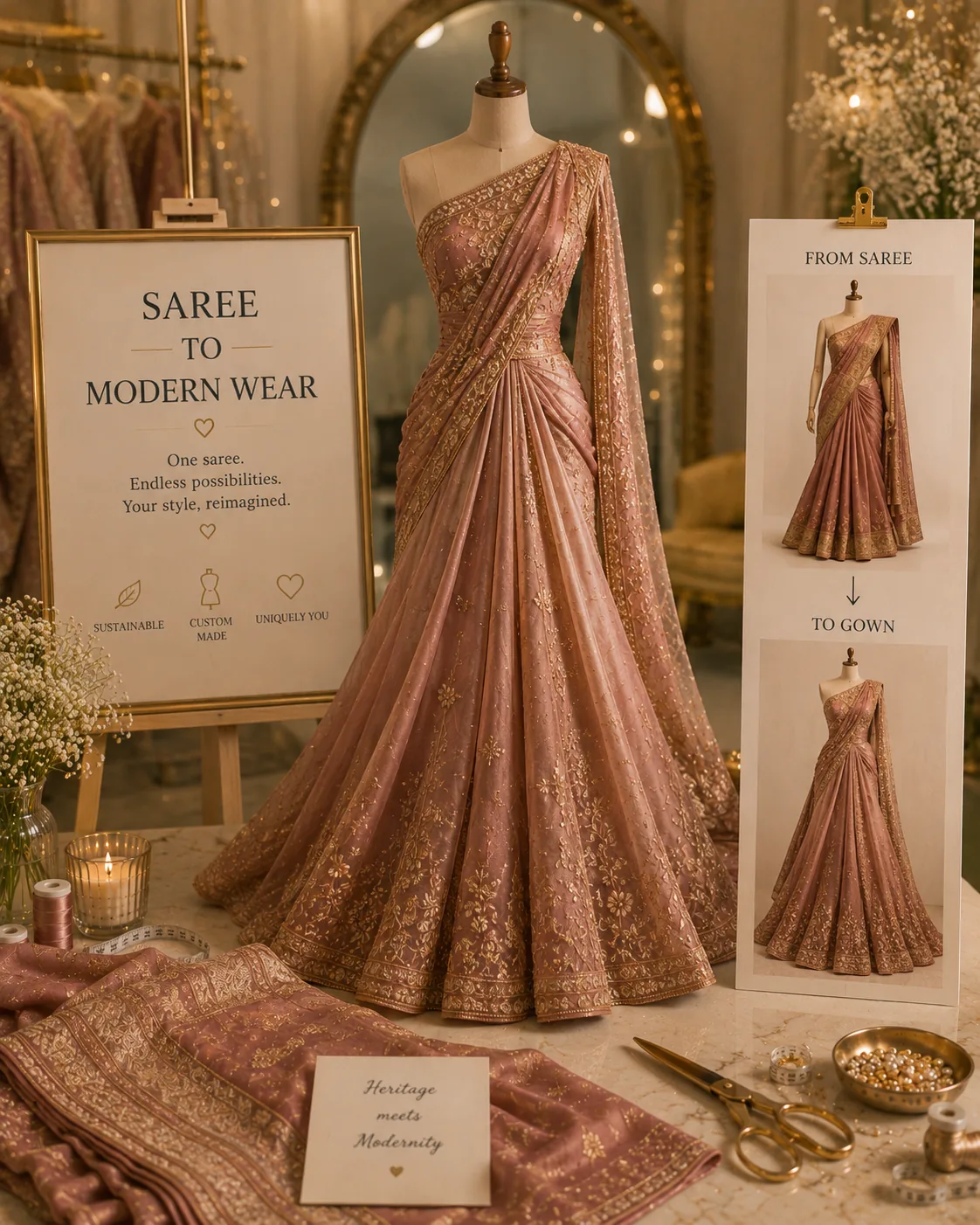
Most women in Chennai have at least one saree that hasn't left the cupboard in years — a wedding gift that never quite suited them, a mother's silk that feels too formal for anything on the current calendar, or simply a saree whose blouse no longer fits. Saree conversion Chennai enquiries are one of the most common requests FABLOON hears in T. Nagar, and the honest answer is that a saree rarely needs to be discarded — it usually just needs a new shape. Saree to modern wear is a design decision, not a compromise, and there are more genuinely wearable outcomes than most customers expect walking in.
Why convert instead of storing it away
A saree carries a lot embedded in it — the weave, the border work, sometimes an emotional history — that a plain wardrobe basic doesn't. Old saree redesign ideas exist precisely because that value is worth preserving in a form you'll actually wear again. FABLOON's team approaches every conversion by first assessing the fabric: its drape, the condition of the border and pallu, and how much yardage is realistically usable, before recommending a direction.
Ten realistic ways to convert a saree
Depending on the fabric, work, and how much of the saree you want preserved, these are the transformations that come up most often in consultations:
- Indo-western co-ord set — the saree fabric reworked into a top and skirt or palazzo pairing that reads modern but keeps the original print or zari.
- Convert saree to gown — a flowing floor-length gown that uses the saree's drape quality and border placement as a design feature rather than hiding it.
- Statement blouse — using the richest section of the pallu or border as a standalone bridal or occasion blouse.
- Crop top and skirt set — a festive-ready two-piece that works for smaller functions and photographs well.
- Cape or jacket over a plain base — the saree becomes an overlay piece rather than the entire outfit, extending its versatility.
- Saree-to-dress — a fitted or A-line dress silhouette for women who want the fabric without the draping effort.
- Fusion saree drape — a pre-stitched or easy-wear reworking of the original saree for effortless everyday styling.
- Half-saree or pavadai-style set — particularly useful for silk sarees being passed down to a daughter or younger relative.
- Coordinated accessories — leftover fabric turned into a potli bag, embroidered clutch or waist belt to accompany another outfit entirely.
- Detachable-element blouse — a blouse built from the saree with a separate sleeve or drape piece, so the same base can be styled more than one way (a direction we cover in more depth in our piece on detachable sleeves).
What decides which conversion suits your saree
Not every saree is a candidate for every transformation. A stiff Kanjivaram silk behaves very differently under a bodice than a soft Georgette, and a heavily worked border limits where seams can fall. FABLOON's consultation process looks at the fabric weight, the placement of embroidery or zari, how much yardage exists after any damage is cut away, and — just as importantly — what you'll actually use the finished piece for. A saree revival meant for a reception photograph needs a different construction than one meant for regular festive wear.
How the process works at FABLOON
You can bring the saree in person to the T. Nagar studio, or start the conversation on WhatsApp with photographs if you're not in Chennai — this is one of the most frequent requests handled through FABLOON's worldwide online stitching workflow. The team assesses the fabric, discusses silhouette options honestly (including telling you if a particular idea won't hold up structurally), and takes measurements either in-studio or by guided video call before construction begins. Because this is custom, one-of-one work, pricing and timelines depend on the saree's condition, the complexity of the chosen design, and current workload — these are best confirmed directly with FABLOON on WhatsApp rather than assumed from a general estimate.
Sarees carry more than fabric value
FABLOON's approach to this work goes back to a simple idea the studio has held since it moved from accessories into full custom clothing: clothes should be made to fit the woman wearing them, not the other way around. A saree conversion is one of the clearest examples of that — the same six or nine yards, reshaped around a life that has moved on from the occasion the saree was originally bought for.
Have a saree sitting unused?
Send us a photo on WhatsApp and we'll talk through realistic conversion options for your fabric.
Send Your Saree Photo