
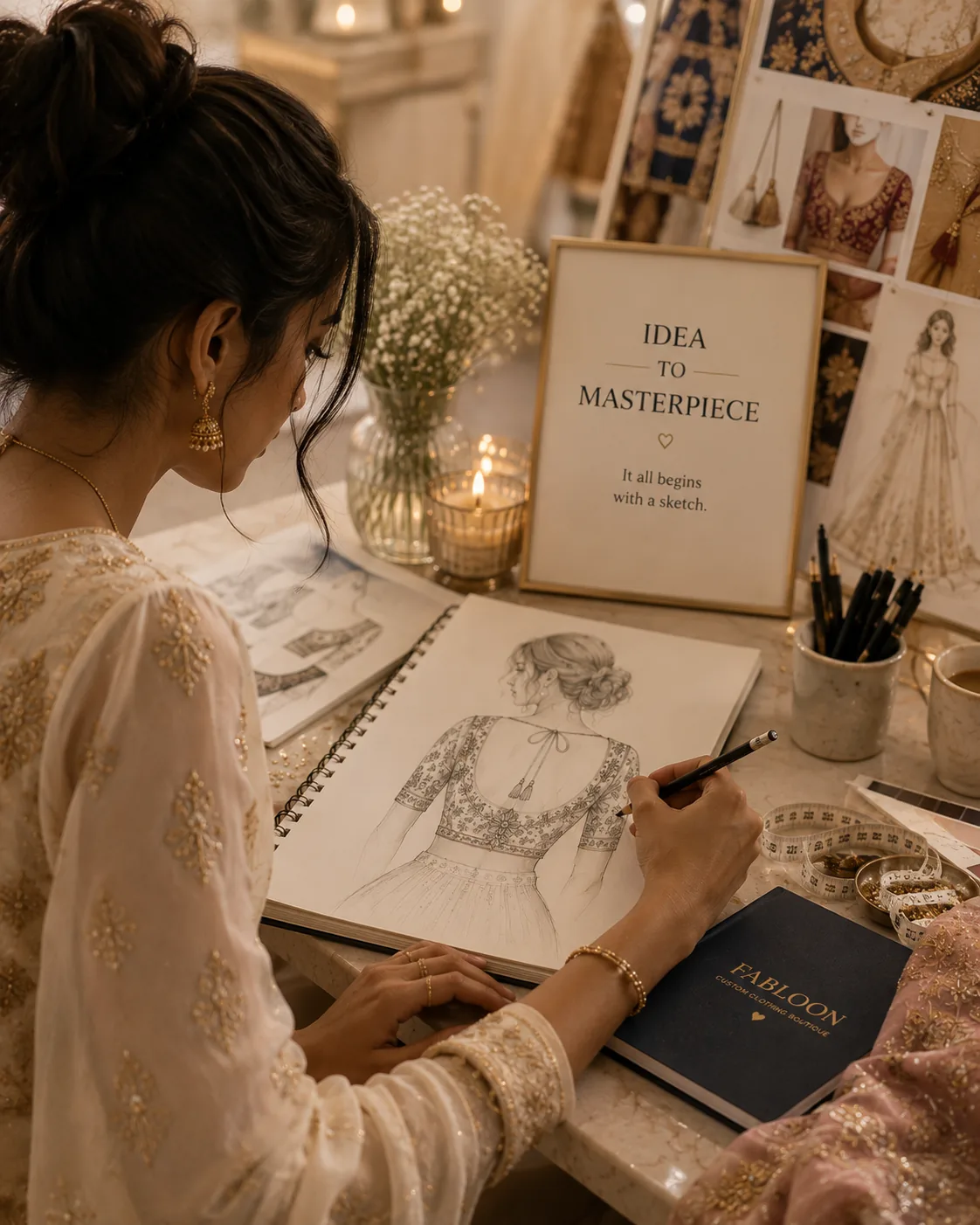
Some of the most memorable pieces FABLOON has produced didn't start with a reference image, a saree, or even a rough sketch — they started with a sentence. "I want to feel like I'm wearing armour, but soft." "Something that moves like water when I walk." A custom concept outfit design in Chennai like this asks for a different process than a standard blouse order, because there's no existing garment to adapt — the outfit has to be built entirely from an idea outward.
Why concept wear needs its own process
Most custom clothing starts with an established garment type — a blouse, a kurta, a lehenga — and customizes it. Couture design from scratch works in the opposite direction: the concept comes first, and the garment type gets decided along the way, sometimes only becoming clear once fabric and silhouette conversations are well underway. This is the process behind FABLOON's red carpet outfit design work, concept gowns, and other one of one outfit Chennai commissions that don't fit neatly into an existing category.
The concept-to-fitting journey
Even without a starting pattern, this kind of custom garment construction process follows a structured path:
- Concept — the idea, feeling, or occasion the outfit needs to express.
- Sketch — translating that concept into a visual direction the team can work from.
- Fabric and design planning — choosing materials and structural elements that can actually deliver on the sketch.
- Measurement — precise fitting, since concept garments often rely on structure and proportion more than a standard blouse would.
- Construction — building the piece, often across multiple specialist hands for embroidery, structure and finishing.
- Fitting — a hands-on check against the body the garment was built for.
- Refinement — adjustments based on how the piece actually sits and moves.
- Final look — the completed outfit, styled and ready.
Because so much of this work is unprecedented for that specific customer, refinement tends to matter more here than in standard stitching — a concept gown designer in Chennai working this way expects to make small structural corrections after the first fitting, not just hem adjustments.
Where this kind of work usually shows up
Concept and red carpet clothing tends to serve specific, higher-stakes occasions: award functions, stage appearances, fashion or editorial shoots, milestone birthdays, pre-wedding shoots, and any event where a woman wants something distinctive rather than a garment chosen from a common pattern. It's also where FABLOON's broader capabilities — corset-based construction, sculpted silhouettes, fusion drapes, detachable elements — tend to come together in a single piece.
What this process asks of the customer
Designing from a blank sheet requires more openness from the customer than adapting an existing reference does, simply because there's less to point at and say "like this." The most successful concept commissions tend to involve customers willing to describe a feeling or mood even before they know what the garment will look like — the visual direction gets built collaboratively from there, through sketches and fabric conversations, rather than arriving fully formed on day one.
Why timelines are longer for concept work
A custom garment built from an existing pattern or reference can usually be estimated fairly quickly, but a one-of-one outfit designed from a bare concept genuinely can't be rushed through the same schedule. Sketching, fabric sourcing and structural planning all take longer when there's no established template to lean on, and refinement after the first fitting is more likely than with standard stitching. As with any express or standard order, pricing and timelines depend on garment complexity, fabric and current workload — this is worth discussing openly with FABLOON early in the concept conversation rather than assuming a fixed schedule.
Where structure and craftsmanship meet
Much of what makes concept wear distinctive comes down to structure — boning, layering, sculpted panels — rather than surface decoration alone. This is where FABLOON's broader craftsmanship comes into play, since a concept gown or corset-based design succeeds or fails on construction quality as much as on the idea behind it. A striking sketch is only the starting point; the finished garment has to actually hold its shape and move the way the concept intended.
Have an idea with no reference to point to?
Tell FABLOON what you're imagining, and the team will help turn it into a wearable concept, step by step.
Start a Concept Design